Events | Hardware | Software
Oct 26, 2026
Beyond the Screen: Medical Display, HMI and Embedded Trends at MEDICA 2026
By: Steven McGough, New Business Development Manager
Choosing a display, touchscreen or embedded platform for a medical device is no longer a standalone decision. Ahead of MEDICA and COMPAMED 2026, here's what that means for designers.
For medical device developers, the engineering brief is changing.
Devices are becoming more connected, processing is moving closer to the edge, and artificial intelligence is entering diagnostics and clinical workflows. At the same time, portable and point-of-care equipment is taking healthcare beyond traditional hospital environments.
Medical Displays Are Becoming Complete HMI Solutions
The display is one of the most important interfaces between a medical device and its operator, and selecting one involves much more than choosing size and resolution.
Engineers may need to consider brightness, viewing angles, touchscreen operation with medical gloves, optical bonding, cover glass, cleaning requirements, mechanical integration, product longevity and power consumption.
The display is fast becoming part of the complete medical HMI architecture, rather than an isolated component, and one that needs to remain available across a long medical product lifecycle.
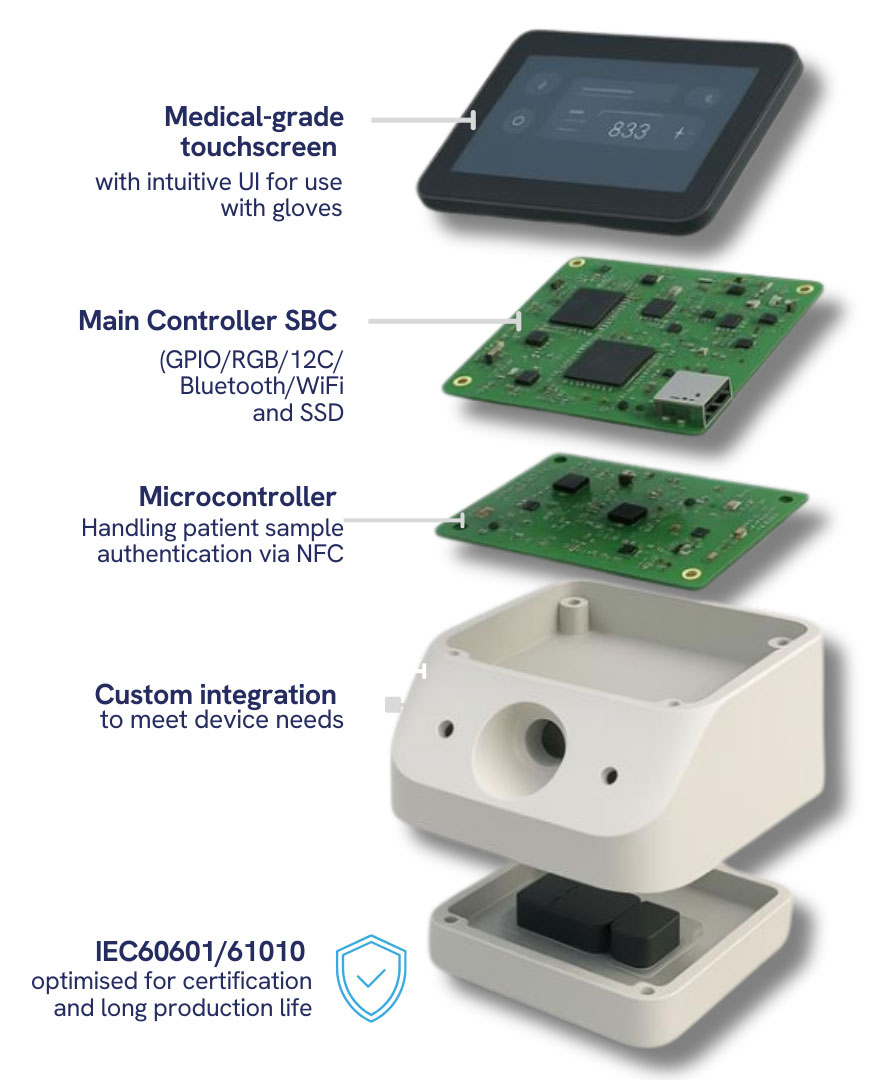
At Anders, we combine TFT display technology, capacitive touchscreens and embedded computing to design and develop integrated user interfaces for medical and healthcare equipment, with optical bonding, glove-optimised touch and IEC 60601-1-2 EMC requirements considered from the start of the design, helping to reduce avoidable risk before accredited testing.
Point-of-Care Diagnostics Move Closer to the Patient
Diagnostic technology is moving closer to the patient, creating demand for compact, portable equipment that can deliver results outside a central laboratory, and that brings real engineering challenges.
Portable equipment needs sufficient processing performance while controlling power consumption. Displays need to remain clear in different lighting conditions, touchscreens may need to work with gloves, and connectivity may be required to transfer results securely into wider healthcare systems.
It's an area where Anders already has hands-on experience, having supported field-based medical testing applications that combine customised sunlight-readable TFT displays, capacitive touch, bespoke cover glass and embedded technology.
Connected Medical Devices and Embedded Computing
Patient monitors, diagnostic equipment, mobile medical devices and other clinical systems are increasingly connected, putting the embedded platform behind the display firmly in the spotlight.
Depending on the application, this might range from an MCU controlling a dedicated touchscreen interface to an ARM-based System-on-Module providing higher-performance processing, wireless connectivity and sophisticated graphics. The right choice depends on the device's performance, power, user-interface, compliance and lifecycle needs, not processing power alone, and it's a decision our embedded engineers help customers make early.
The conversation is moving from simply designing a medical device towards developing an intelligent, connected one, with security designed in from day one.
Case Study: Medical Device
Edge AI Moves into Medical Equipment
AI will be one of the major conversations at MEDICA 2026, and the development we're most interested in is edge AI: rather than transferring all information to the cloud, suitable embedded platforms can perform certain AI workloads locally.
For applications involving medical imaging, sensors or diagnostic data, local processing can potentially provide faster responses, reduce network dependency and limit the amount of information that needs to leave the device. The right platform depends on the real inference workload: the model, memory, thermal and power constraints matter more than a headline TOPS figure.
As medical equipment generates ever more data, embedded computing and edge AI will become key design considerations, and they're topics our embedded team is keen to discuss at the show.
Why COMPAMED 2026 Matters
While MEDICA focuses strongly on healthcare technologies and applications, COMPAMED 2026 provides another important perspective: the technology inside those products.
One of this year's key topics is Secure Connectivity & Embedded Intelligence, reflecting the growing importance of connected electronics, energy-efficient sensing, secure communications and security-by-design.
It reflects a change we're already seeing with customers: the question is moving beyond “Which display should we use?” to “How should we build the complete display and embedded architecture behind this device?”
That's exactly where Anders adds value: bringing display, touch, embedded computing and connectivity together through a single engineering and supply partner, from concept through to production and long-term supply.
For Anders, the interesting question isn't simply what the next medical display will look like.
It's how display technology, touchscreen HMI, embedded computing, connectivity and edge intelligence can work together to create medical devices that are easier to use, quicker to bring to production and supported throughout their lifecycle.
Our team will be at MEDICA and COMPAMED in Düsseldorf from 16–19 November 2026, and we'd love to meet you.
Connect with Steven McGough on LinkedIn
Connect with Henk Snijders on LinkedIn